

By Tyler Plack
Tyler Plack is the Chief Executive Officer of South River Mortgage. He joined the company as a founding employee in 2017 and served as President before becoming CEO in 2026. Tyler holds an active FHA Direct Endorsement (DE) underwriting certification.
If you’ve never had a reverse mortgage before, the process may seem confusing.
What paperwork do you need? When do you get an appraisal? When do you talk to a counselor? How long does everything take?
The good news is that the process is easier to understand when you break it down into steps.
Here is what to expect when applying for a Home Equity Conversion Mortgage (HECM), the FHA-insured reverse mortgage program.

In this article14 sections
- Step 1: See If You May Qualify
- Step 2: Complete Reverse Mortgage Counseling
- Step 3: Complete Your Application
- Step 4: Your Home Is Appraised
- Step 5: Your Financial Information Is Reviewed
- Step 6: Title and Other Property Information Is Checked
- Step 7: The Loan Goes Through Underwriting
- Step 8: Review Your Final Loan Terms
- Step 9: Close Your Reverse Mortgage
- Step 10: You Have Time to Review the Decision
- How Long Does the Process Take?
- The Bottom Line
- See What You May Qualify For
- Frequently Asked Questions
Step 1: See If You May Qualify
The first step is to find out whether a reverse mortgage could work for you.
For a HECM, the youngest borrower must be at least 62. Your home must also meet program requirements, and the amount you may be able to borrow depends on factors such as your age, home value, interest rate, and existing mortgage balance.
Talk with our reverse mortgage professionals. They can give you an idea of how much you may qualify for and discuss what you want the money to accomplish.
No obligations, just answers when you call us at 855-212-9114.
Step 2: Complete Reverse Mortgage Counseling
Before a HECM application can move forward, you must complete counseling with a HUD-approved HECM counselor. The counselor is there to help you understand the loan and your other options.
During counseling, you can ask questions about costs, repayment, your financial situation, and what could happen to your home in the future.
After counseling, you receive a Certificate of HECM Counseling. This certificate becomes part of your loan file.
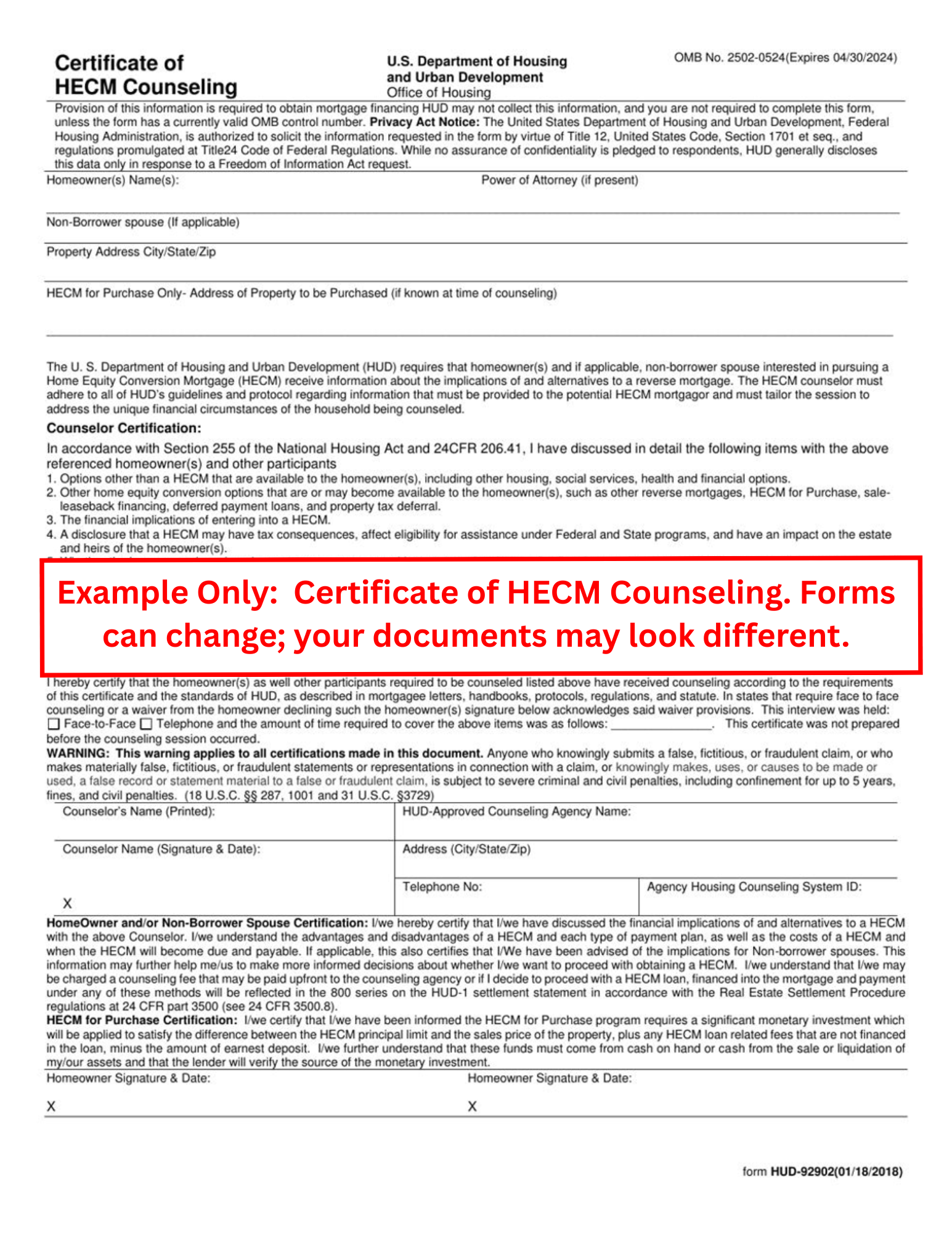
Example: Certificate of HECM Counseling. Forms and versions can change, so your actual document may look different.
Step 3: Complete Your Application
Once counseling is complete, you can move forward with the loan application.
Your lender will ask for information about you, your home, your income, your debts, and your financial situation. You may also need documents such as a photo ID, Social Security number verification, your deed, information about existing liens, and your counseling certificate.
Your lender will explain what documents are needed for your specific situation.
Step 4: Your Home Is Appraised
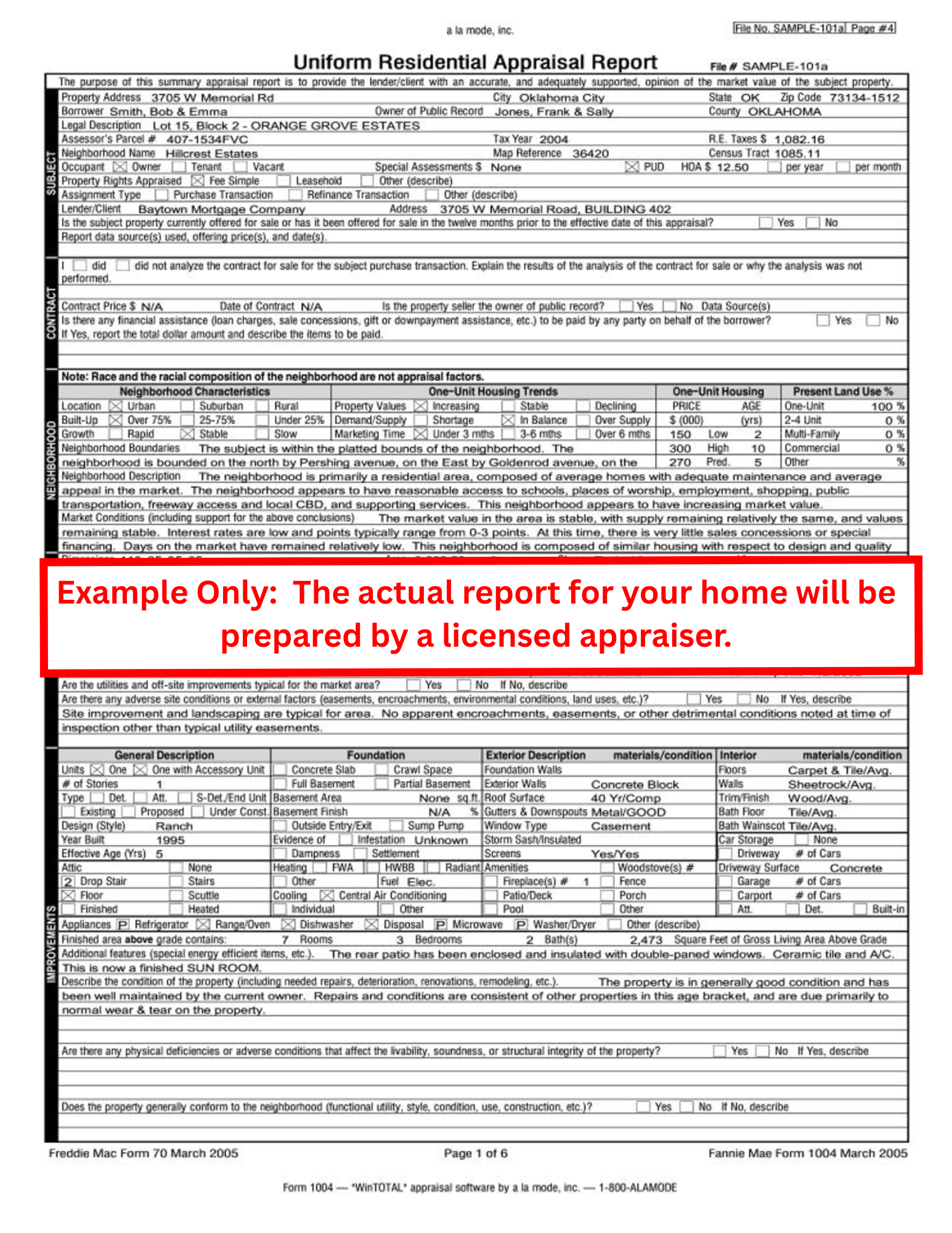
Next, an appraisal is completed to determine the current value and condition of your home.
An appraiser will visit your home and look at things such as its size, condition, features, and location. The appraisal helps determine how much you may be able to borrow.
If the appraiser finds certain repairs that are needed, those repairs may need to be completed before closing. In some cases, money may be set aside from the loan to handle required repairs.
Step 5: Your Financial Information Is Reviewed
We’ll review your financial information to make sure the loan meets HECM requirements.
This can include looking at your income, monthly expenses, credit history, debts, and property charges such as taxes and insurance. The HECM financial assessment also looks at whether you have enough remaining income to meet your financial obligations.
This step helps determine whether there are conditions that need to be addressed before the loan can close.
Step 6: Title and Other Property Information Is Checked
We will also make sure you have clear ownership of the property and identify any existing liens or debts secured by the home.
A title search and other property-related services are generally ordered during the processing stage. If you have an existing mortgage, it generally must be paid off as part of the reverse mortgage transaction.
You may be asked for additional documents if there are questions about ownership, previous mortgages, liens, or the property itself.
Step 7: The Loan Goes Through Underwriting
Once the required information has been collected, your loan goes to underwriting.
The underwriter reviews the application, financial information, appraisal, title information, and other required documents. They make sure the file meets the requirements for the loan.
If something is missing, your lender may ask you for another document or clarification. This is normal and doesn’t necessarily mean there is a problem with your loan.
Check your eligibility
A few details to help us understand your options.
Step 8: Review Your Final Loan Terms
Once the loan is ready to close, you’ll receive the final loan documents.
This is an important time to slow down and read everything carefully. Your loan officer can explain the documents and answer questions about your interest rate, available proceeds, fees, payment plan, and other terms.
Your reverse mortgage may provide funds through a line of credit, monthly payments, a lump sum, or a combination, depending on the loan and payment plan you choose.
Step 9: Close Your Reverse Mortgage
Closing is when you sign the final loan documents.
A closing may take place at a title company, with the lender, or in another approved setting. Some states may require an attorney to be present.
You don’t need to memorize every document. Your job is to read the documents, ask questions, and make sure you understand what you’re signing.

Step 10: You Have Time to Review the Decision
For most HECM transactions, borrowers have three business days after closing to cancel the loan, also known as a right of rescission. There is an exception for HECM purchases.
After that period, the loan can move forward, and funds can become available according to the terms of your loan.
Your lender or servicer will also explain what you need to do after closing to keep your reverse mortgage in good standing.
What Paperwork Will I Need?
Every borrower is different, so there isn’t one checklist that applies to everyone.
However, you may be asked for items such as:
- Photo identification
- Social Security number verification
- Deed or other proof of ownership
- Information about your current mortgage
- Information about other liens on the property
- Income information
- Bank or asset information
- Property tax information
- Homeowners insurance information
- HECM counseling certificate
- Loan application and required disclosures
HUD’s HECM lending guidance specifically lists items such as photo ID, Social Security verification, the deed, information on liens, and the counseling certificate among documents that may be required.
The exact list depends on your situation.
How Long Does the Process Take?
There isn’t one timeline for every reverse mortgage.
Some loans move quickly when the home, title, financial information, and paperwork are straightforward. Others take longer if repairs are needed, title issues have to be resolved, or additional documentation is required.
The best way to keep things moving is to respond quickly when your lender asks for documents or information.

The Bottom Line
Getting a reverse mortgage may seem like a lot of steps, but you don’t have to figure it all out by yourself.
The process generally starts with learning whether you may qualify, followed by required counseling, an application, appraisal, financial and property review, underwriting, and closing.
The most important thing is to understand your options before you sign anything.
A reverse mortgage is a long-term financial decision. Take your time, ask questions, and make sure you understand how it fits into your retirement plans.
See What You May Qualify For
Wondering how much you might be able to access from your home?
Get a reverse mortgage quote from South River Mortgage and see what options may be available based on your age, home value, mortgage balance, and other factors.
There is no obligation to move forward. Get your questions answered and see if it is right for you.
Frequently Asked Questions
Do I have to complete counseling before applying for a reverse mortgage?
For a HECM, counseling must be completed before the lender can process the loan application in the normal HECM process. You’ll receive a counseling certificate after completing the session.
What documents do I need for a reverse mortgage?
The exact list depends on your situation. You may need identification, Social Security verification, your deed, information about your mortgage and other liens, financial information, property tax and insurance information, and your HECM counseling certificate.
Do I need an appraisal?
Yes. A HECM generally requires an appraisal to determine the value and condition of the property.
What happens if my home needs repairs?
If the appraiser identifies certain repairs that are needed for the property to qualify, those repairs may need to be completed. Depending on the situation, some repairs may be handled after closing through a repair set-aside.
Will someone check my credit?
Your financial situation is reviewed as part of the HECM financial assessment. The lender may obtain a credit report and review your debts and financial obligations.
How long does it take to get a reverse mortgage?
The timeline varies. The appraisal, title work, financial review, repairs, and how quickly documents are provided can all affect the timeline.
Can I change my mind after closing?
For most HECM transactions, you generally have three business days after closing to cancel the loan. HECM purchases are an exception.
What happens after the reverse mortgage closes?
Once the loan closes and any applicable rescission period has passed, funds can become available according to your selected payment plan and loan terms. You must continue meeting the loan requirements, including keeping property taxes and homeowners’ insurance current and maintaining the home.